Vaccines against rabies polio the Salk vaccine some forms of influenza and cholera are made from inactivated microorganisms. It is less likely to cause adverse reactions than a vaccine containing the whole virion.
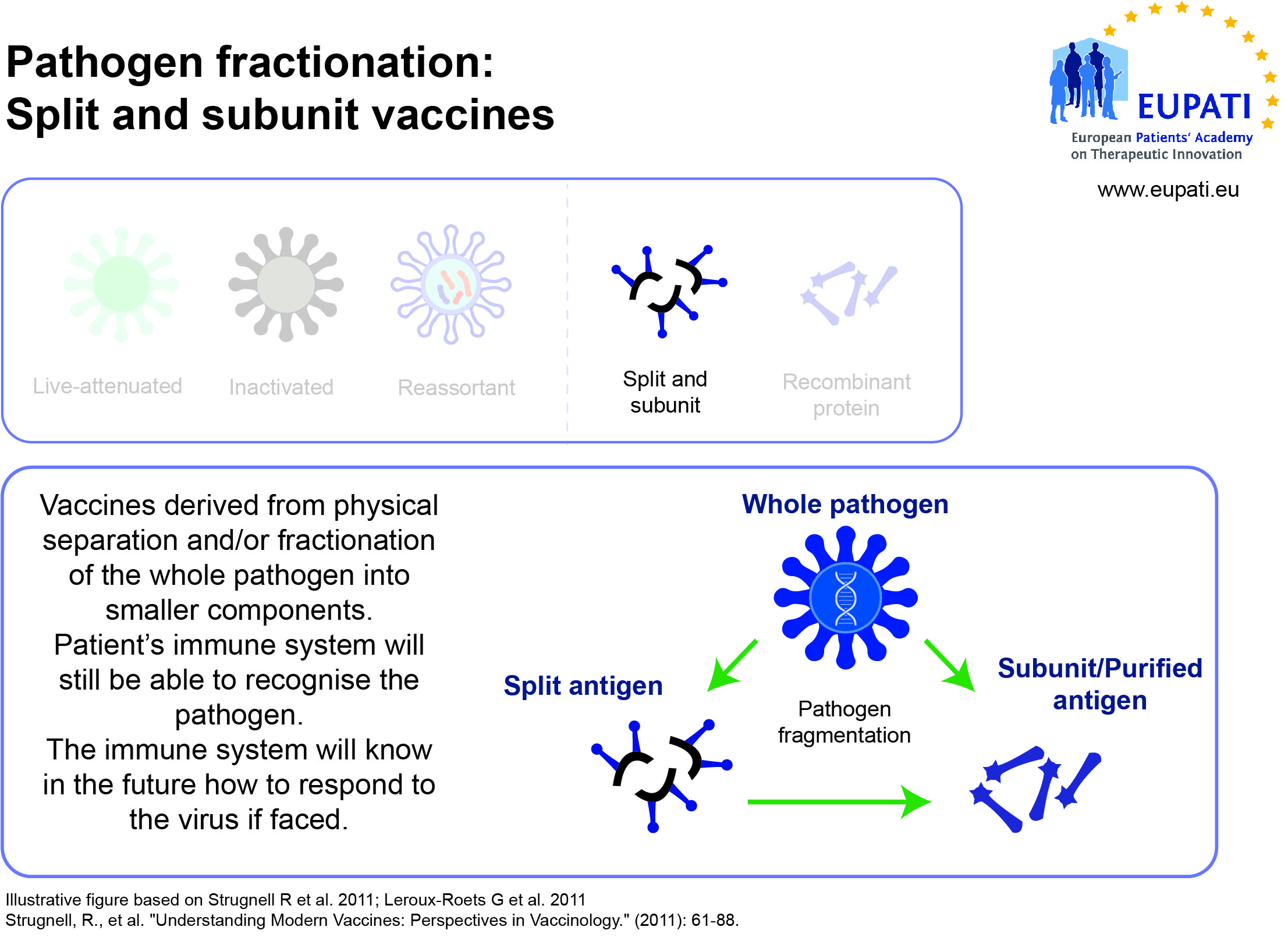 Types Of Vaccines Eupati Toolbox
Both trivalent or quadrivalent inactivated and live attenuated influenza vaccines are available.

Subunit vaccine definition. PAMPs can act as adjuvants however many pathogen-derived products might exhibit toxic activity. Today in modern countries almost all people are vaccinated which has caused many serious diseases to become rare. Subunit vaccines are likely to lack the molecular cues needed for efficient activation of the innate immune system thereby failing to induce vigorous adaptive immunity.
Subunit vaccine a vaccine produced from specific protein subunits of a virus and thus having less risk of adverse reactions than whole virus vaccines. Subunit vaccines show antigens to the immune system without introducing virus material. A subunit vaccine is a vaccine that contains isolated proteins from a virus but lacks viral nucleic acid.
Subunit vaccines use only part of a target pathogen to provoke a response from the immune system. A vaccine containing viral antigens made free of viral nucleic acid by chemical extraction and containing only minimal amounts of nonviral antigens derived from the culture medium. Subunit recombinant polysaccharide and conjugate vaccines use specific pieces of the germ like its protein sugar or capsid a casing around the germ.
As of January 2021 the only authorized vaccine of this type is the peptide vaccine EpiVacCorona. A subunit vaccine consists of a part of the virus typically a protein capable of generating a protective immune response in immunised persons. Another type of vaccine is a subunit vaccine which is made from proteins found on the surface of infectious agents.
These vaccines expose the body to antigens so it can learn to recognize them without exposing the body to the risk of viral replication and subsequent infection. Subunit vaccine synonyms subunit vaccine pronunciation subunit vaccine translation English dictionary definition of subunit vaccine. Rather than introducing an inactivated or attenuated micro-organism to an immune system which would constitute a whole-agent vaccine a subunit vaccine uses a fragment of it to create an immune response.
Although this design can make vaccines safer and easier to produce it often requires the incorporation of adjuvants to elicit a strong protective immune response because the antigens alone are not sufficient to induce adequate long-term immunity. A preparation of a weakened or killed pathogen such as a bacterium or virus or of a portion of the pathogens structure that is administered to. Subunit vaccine a vaccine produced from specific protein subunits of a virus and thus having less risk of adverse reactions than whole virus vaccines.
This may be done by isolating a specific protein from a pathogen and presenting it as an antigen on its own. The acellular pertussis vaccine and influenza vaccine in shot form are examples of subunit vaccines. The antigens involved are often protein subunits but can be any molecule that is a fragment of the pathogen.
Subunit vaccines present one or more antigens without introducing whole pathogen particles. From the Cambridge English Corpus The other subunit combinations would also be sensitive to zinc but to a lesser extent. Vaccines for influenza and hepatitis B are of that type.
The only globally approved adjuvant for humans is alum. The most advanced subunit vaccine is being developed by Hawaii Biotech Inc and is based on the envelope E protein produced in the Drosophila S2 expression system whereby glycosylation is maintained and immunoaffinity purified in order to achieve conformational folding. Because these vaccines use only specific pieces of the germ they give a very strong immune response thats targeted to key parts of the germ.
Whole-virus vaccines split-virus vaccines and subunit vaccines. Subunit Vaccines Instead of the entire pathogen subunit vaccines include only the components or antigens that best stimulate the immune system. In most countries whole-virus vaccines have been replaced by less reactogenic split virus and subunit vaccines.
Approved subunit vaccines The first subunit vaccine to be approved for use in humans in the United States is the hepatitis B vaccine which comprises hepatitis B virus surface antigens HBsAg that. Most of the vaccines in the UK schedule are subunit vaccines which do not contain any whole bacteria or viruses at all. Acellular means not containing any whole cells Instead these kind of vaccines contain polysaccharides sugars or proteins from the surface of bacteria or viruses.
There are three types inactivated vaccines. Subunit vaccine səbyünit vaksēn immunology A type of noninfectious vaccine that consists of immunogenic viral proteins stripped free from whole virus particles then purified from other irrelevant components thereby reducing the risk of adverse reactions and residual infectious virus. One example is the subunit vaccine against hepatitis B virus that is composed of only the surface proteins of the virus previously extracted from the blood serum of chronically infected.

